The Great Rewiring
Why Our Kids Are Anxious and What We Can Do About It
As a Millennial parent, I often feel like I’m living in two different worlds. I remember a childhood spent roaming the neighborhood until the streetlights came on, a time when the "internet" was the screeching sound of a dial-up modem and a social life was managed by passing notes in the hallway. I watched it all emerge: the novelty of everyone getting an email address, the constant buzz of early messaging apps, and the pivotal moment in university when a Facebook profile transformed from a distraction to a necessary tool for coordinating group projects. We were the test pilots for this digital revolution, learning to navigate the new frontier of online connection and awkwardness as we went.
But now, as parents, we're facing something far more daunting. The technology is no longer emerging; it has erupted, and its evolution is happening at a speed far outpacing our ability to grasp its long-term impact. We are the first generation of parents raising "digital natives," and we're doing so without a map. We know in our gut—and now, from the mounting research—that this constant connectivity is fundamentally altering developing brains. Yet, we are trapped in a relentless cycle of practicality and pressure. A tablet is a moment of quiet for a parent overwhelmed by work and life. A smartphone is the lifeline of our child’s social world. And the social expectation to be online isn’t just for them; it’s for us, too. We are caught in the middle, armed only with our analog childhoods as a guide, trying to protect our kids from a world we were never raised in and are still struggling to understand ourselves.

Photo by Margo Evardson on Unsplash
Unpacking "The Anxious Generation"
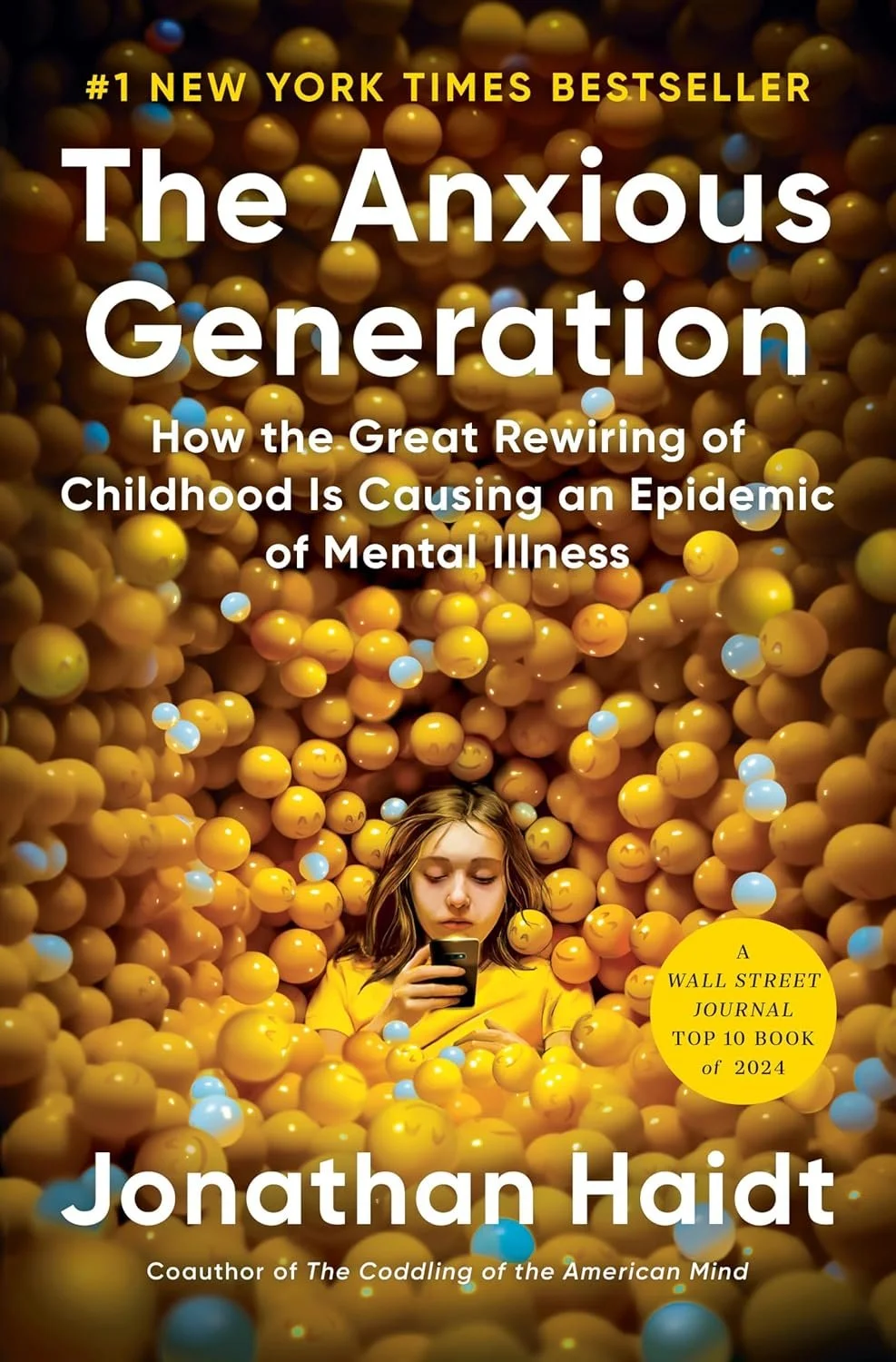
Have you ever felt like parenting in the digital age is an impossible tightrope walk? On one side, we're told to give our kids more independence and free play. On the other, we're bombarded with warnings about online predators, social media addiction, and cyberbullying. In his groundbreaking book The Anxious Generation, social psychologist Jonathan Haidt argues that we've gotten this balance catastrophically wrong—and our children's mental health is paying the price.
Haidt's central claim is powerful in its simplicity: we have created a "phone-based childhood" that has replaced a "play-based childhood.” This "great rewiring" of childhood, driven by the twin forces of overprotection in the real world and underprotection in the virtual world, is the primary cause of the epidemic of anxiety, depression, and self-harm we see in Gen Z (those born after 1995).
The Two-fold Problem
The Decline of the Real-World "Apprenticeship": We've stripped away the unsupervised, risk-filled play that teaches children resilience, social skills, and how to navigate conflict. Haidt argues that by making physical worlds too safe and schedules too structured, we've deprived kids of the essential "antifragile" experiences they need to handle adversity as adults.
The Unregulated Virtual Experiment: At the same time, we've handed them smartphones and unrestricted access to social media platforms, which Haidt likens to a massive, uncontrolled experiment on our children. These technologies, designed to maximize engagement and profit, expose them to chronic social comparison, harassment, and curated perfection at a developmentally vulnerable time.
The Evidence:
Haidt roots his argument in stark data, pointing to a dramatic and synchronized downturn in youth mental health starting around 2010-2012—precisely when smartphone and social media adoption saturated adolescence. He meticulously charts the rise in anxiety disorders, major depression, self-harm, and suicide rates, making a compelling case for correlation and causation.

Photo by Markus Spiske on Unsplash
A Path Forward: Solutions, Not Just Diagnosis
The book isn't just an alarm bell; it's a manifesto for change.
Haidt proposes collective action to establish new norms, including:
No Smartphones Before High School: Delaying smartphone access until at least 9th grade.
No Social Media Before 16: Legislating a higher minimum age for social media accounts.
Phone-Free Schools: Mandating that phones be locked away for the entire school day to restore focus and face-to-face connection.
More Independence, Free Play, and Responsibility: Actively working to bring back unsupervised play and real-world experiences for children.
Why This Matters for Parents (and Everyone):
The Anxious Generation moves the conversation beyond individual guilt ("I should limit screen time more") to a societal imperative. It frames the crisis not as a failure of individual parents, but as a collective action problem we can solve together. The message is ultimately hopeful: by rewiring childhood back to align with human biology instead of algorithmic economies, we can foster a healthier, more resilient generation.
Call to Action/Closing Thought:
Reading Haidt's book can feel like having a fog lift. It names the unease so many of us feel and provides a clear, research-backed framework for understanding it. The question it leaves us with is: How can we, in our families, schools, and communities, start to roll back the phone-based childhood and restore the essential ingredients of a real one? As governments like Australia and Canada take bold steps, the burden shifts to all of us to support these new norms and fill the void with richer, real-world experiences.
A Global Response: From Australia's Ban to Canada's "Redesign"
The crisis Haidt describes is now spurring unprecedented government action. Nations are moving beyond warnings to concrete legislation, creating a real-time test case for his proposals.
Australia led the world by enacting a law in December 2025 that bans children under 16 from social media platforms like TikTok, Instagram, and YouTube. The onus is on companies to identify and remove underage accounts, and early data shows the policy has force, with platforms revoking access to about 4.7 million accounts identified as belonging to children in its first month.
Canada has just introduced its own legislation (Bill C-34, the Safe Social Media Act) in June 2026. While also targeting a ban for under-16s, Canada's approach is distinct. It includes a potential exemption for platforms that can prove they have implemented rigorous safety standards to minimize harm to minors. Analysts note this creates a "more complex set of platform obligations" aiming not just to restrict access, but to fundamentally "redesign of the social media ecosystem to make it safer for children." This represents a different philosophical approach: Australia is building a wall, while Canada is attempting to force a safer playground.

Photo by Melissa Askew on Unsplash
Professional Disclosure:
My Recommendation: As a psychologist, I frequently recommend books and resources to clients and the public that I find professionally valuable. Jonathan Haidt's The Anxious Generation is one such resource, as it synthesizes crucial research on the factors contributing to the youth mental health crisis.
Affiliate Link Notice: The link provided to Amazon is an affiliate link. This means that if you click on the link and subsequently purchase the book, my practice may earn a small commission from Amazon.
Transparency, Integrity, and Boundaries: The presence of an affiliate link does not, in any way, affect my professional opinion or recommendation. This blog post is an educational resource provided to the general public and is not tied to my clinical practice. There is no expectation for clients or prospective clients to purchase this book as part of any treatment plan. I am bound by my ethical code to provide unbiased and helpful information. Any commissions earned are used to offset the costs associated with maintaining this educational website. I appreciate your understanding and support.
Reference List
Haidt, J. (2024). The anxious generation: How the great rewiring of childhood is causing an epidemic of mental illness. Penguin Press.
Parliament of Canada. (2026). Bill C-34: An Act to enact the Digital Safety Act and the Digital Safety Commission of Canada Act and to make consequential amendments to other Acts (First Reading). Retrieved from https://www.parl.ca/DocumentViewer/en/45-1/bill/C-34/first-reading4
Department of Canadian Heritage. (2026, June 10). Bill C-34, the Safe Social Media Act. Retrieved from https://www.canada.ca/en/canadian-heritage/services/safe-social-media-act.html2
Australian Parliament. (2024). Online Safety Amendment (Social Media Minimum Age) Act 2024.
eSafety Commissioner. (2025, July). Online Safety (Age-Restricted Social Media Platforms) Rules 2025.
Geist, M. (2026, June 11). Taking stock of Bill C-34: Five things to know about the government's plan for a kids' social media ban, mandated age verification, and AI chatbot rules. Retrieved from https://www.michaelgeist.ca/2026/06/taking-stock-of-bill-c-34-five-things-to-know-about-the-governments-plan-for-a-kids-social-media-ban-mandated-age-verification-and-ai-chatbot-rules/4